Friday, November 18, 2011
Monday, November 7, 2011
Point of View
A new series
Look around office and workplaces of today.
Have they changed in the last fifty years?
Of course they have. Instead of the individual cabins most work places have opted for open offices.
What about your kitchen?
Is it still the smoke filled place with soot encrusted walls?
Now, think of the schools of today.
Have they changed just as dramatically in the last fifty years?
The class room may have white boards instead of blackboards but schools are still designed as rows of rooms lined along a corridor aligned with some open spaces.
We talk about schools of tomorrow that help our children develop 21 st century skills. Well, pause and ponder- can 21 st century skills be taught within the confines of spaces that are outdated and inefficient?
Schools can offer fantastic opportunities for young children to learn and grow not just because of the materials and teaching learning opportunities they house but through creative and innovative use of spaces that encourages children to explore, experiment, create, collaborate and express.
And who better to help us visualize the school for the future than the ones who are going to use it the most. Here we have children share their vision of the school they would like to study in and share the rationale for their design.
Indeed a rich food for thought for architects, school owners, teachers and parents.
Friday, October 21, 2011
A Picasso in Making
All young children are imaginative. We only need to look at a three year olds drawing and ask her to describe it. A long story with unpredictable twists and turns is sure to emerge.
Research in developmental psychology clearly indicates imagination and creativity are closely linked. Children imagine, experience, make meaning and express themselves in novel ways.
It is obvious that creativity is a cognitive trait that requires concentration, logical thinking and decision making. Yet it is also a personality trait that requires ability to take risks, work with complete dedication and independence.
All these traits are clearly evident in Tulika’s painting. She spent four months working on it without really knowing what the outcome will be.
Tulika’s work clearly highlights how mentors can support creativity by creating an environment where children are allowed enough time and mental space to be creative.
Not only this will help children grow into confident individuals but will also equip them with intellectual flexibility. So while they will be able to write new songs or paint different pictures they will also be able to use their ability to think differently to solve real life problems at home or at workplace.
Friday, October 7, 2011
Thoughts about a Pot
Children, especially those in large cities, are enamored by technology and fascinated by gadgets. They seek instant gratification and constant stimulation. This is what makes them overlook the diminutive beauties of life and results in children being not reflective enough.
Isn’t this akin to what many of us, as adults, perceive about the children of today? We consider children as superficial in their thought and behavior unable to perceive the nuances of real life.
Here we present to you the work of 12 year old Dhruv which has made many adults reflect on their acuity about the children of today. Dhruv’s keen observation, his ability to connect with small details in the real world, to internalise, ruminate and express deep thoughts is what has taken many by surprise.
I am really interested in acting and sketching. I play piano and compose music of my own. Apart from this, playing games is something I love.
In school, we made some pots. I was very happy with the way my pot was looking. But, when our pots came back from glazing, they looked so uninteresting. This made me really disappointed.
The person who sent our pots back said that he tried to find an ode for a pot to console us but couldn’t. That’s when I decided to write an ode for my pot.
I showed this ode to my class teacher. Everyone liked it so much that they decided to include it in the pottery manual for reference. I never thought thiswould come out so well. It feels great to get so much appreciation.
Certainly, yes! Even presently, I am writing a comic book. Once I complete it, I would get it published.
Dhruv’s work and a one-to-one conversation with him left us with many questions.
Are the children of today really not allied to nature?
Do they really fail to spot the small details and little beauties that life has to offer?
How many of us, as adults, will be fascinated by an object as mundane as a pot and will use it as a
starting point to derive such deep meaning from a simple every day experience?
Friday, September 16, 2011
The Humorous Homework
Most of us were not too fond of History when we were in school. Yet we were fascinated by the comic books that narrated stories of historical characters and olden times.
History can be fascinating - if it opens a window to the past- when life was full adventure, intrigue and accomplishment or it can be tedious if it is all about listing of dates, rulers and dynasties.
This brings us to the moot question why do children find a certain subject boring in class. The most obvious response is how it is taught in school.
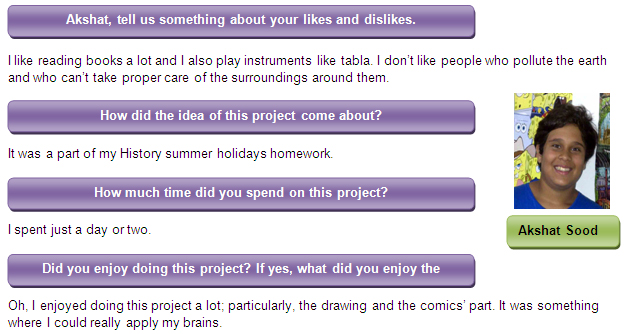
Here we showcase a History project done by Akshat as a part of a school assignment. Notice how the idea of creating a comic strip piqued the child’s imagination and encouraged him to think out of the box. Notice how a mundane project that could have involved simple downloading of pictures and information from the internet became an absorbing endeavour that showcases not just Akshat’s understanding of costumes down the ages but also his creativity, his skill at visualisation and his sense of humour.
Akshat’s project clearly shows us his wit and inventiveness. We, at Inspire, believe that every child possess an inherent creativity and intellect to come up with something original.
Therefore, as mentors, it is important for us to reflect on some vital questions.
Can we think beyond obvious kinds of assignments to trigger that inherent creativity of a child?
Can we try out innovative ideas to engage, challenge and motivate students?
Can we make a subject interesting for a child by the way we approach it?
Friday, September 2, 2011
Writing a Novel – It’s Just a Child’s Play
In the last blog post we shared some parents’ perceptions about their children. I am sure many of these thoughts resonate with what we think about the children of today.
We now showcase some samples of children’s work and hear their voices in an attempt to understand what interests, engages, motivates, and excites them. With this we would like all adults to re-examine their assumptions of children and see how valid or relevant these are.
Here, we present a novel written by 11 year old Yash Pradhan. Rather than introducing him formally we urge you to carefully go through what he says about himself at the end of the book.
1. Yash how did the idea of this book come about?
I was playing in the lawns with my Dad on a full moon night. That is when we both started talking about moon, earth, universe and all.
I felt like writing something about it. So, I did a little research on the internet about the topic. Finally, I wrote this book.
2. Tell us more about your interests.
I am extremely interested in Tennis. I go for Tennis classes daily. And, apart from tennis, I think my guitar is something that I am really interested in.
3. When you grow up, would you like to take up writing as a profession?
Writing is more of a hobby for me. I like writing when I am free. I am clear that when I grow up I will become a Computer Engineer because I am very passionate about Computers.
This one to one conversation with Yash Pradhan popped so many questions in our minds. Are the Children of today really careless and confused? Do they really lack an eye for detail? Are they really lacking focus in their lives?
Friday, August 19, 2011
Khalil Gibran said
Your children are not your children.
They are the sons and daughters of Life's longing for itself.
They come through you but not from you,
and though they are with you yet they belong not to you.
As adults we are fascinated and exasperated in equal measure by children of today. ‘They are sooo smart!’ exclaims a parent about her children who create rap songs or score high on a game of ‘Angry Birds’. Teachers, on the other hand, feel that children do not respect Indian values and argue incessantly. They, also, complain about how children are restless and have poor attention span and those who write answers as if they are writing a sms or a tweet. Then, we see these child prodigies on television who dance to the latest Bollywood hits or belt out jokes in comedy shows.
In this blog series we begin by interviewing three parents to find out what they think about children of today.
Saroj Chowla
1. According to you, what interests the Children of today?
I interact with two set of Children- one who attend the Art of Living classes and the other who attend the present day schools. I feel those who are associated with the Art of Living classes are more close to our Indian values and cultural heritage. On the contrary, children attending the present day schools have a greater western influence on them.
2. How do you think are the Children of today different from what you were as a child?
As a child I was more innocent. I was happy with my upbringing. I was more accepting of the decisions that my elders took for me. However, the children of today don’t acknowledge the experience that elders have and end up being confused.
3. What do you think are the Children of today missing and lacking in their lives?
They are very touched by materialism. This makes them miss on the joy that little moments in life can bring.
Sarika Thukral
1. According to you, what interests the Children of today?
Largely, I think they are interested in television, their friends and a kind of music that is not at all soulful. Even, the friendships they have don’t seem to have any quality to them.
2. How do you think are the Children of today different from what you were as a child?
I was more inclined towards music that is meaningful and friendships that are qualitative. I used to play a lot of outdoor games. This made me evolve as a more focused person in life. Today’s children are simply not focused.
3. What do you think are the Children of today missing and lacking in their lives?
They are missing badly on relationships. They are lonelier.
Arnav Sood
1. According to you, what interests the Children of today?
According to me, the children of today have a keen interest in sports and computers. These are the two things that almost all of them are really good at.
2. How do you think are the Children of today different from what you were as a child?
Thanks to technology, the children today are more exposed to the world around them. It isn’t limited to their immediate surroundings.
3. What do you think are the Children of today missing and lacking in their lives?
I will say that they are missing on the cultural values. We were more attached to our relatives and extended family.
In these interviews, we heard the perspective of parents and grandparents about the children of today. In the following weeks, we will unravel whether children share the same perspective. So in our following blog series’ A Window into the World of Children, get ready to meet the child of the 21st century and get an insight into their fascinating world.
Hear them talk about what motivates and excites them, their interests and their aspirations…
Subscribe to:
Posts (Atom)